Louvered vs Traditional Pergola in Florida: Pros and Cons

Here’s a conversation we have a lot: someone comes to us after spending an afternoon under a traditional open-lattice pergola in their backyard during a July rainstorm, soaked through and frustrated, wondering why they spent money on something that doesn’t actually protect them from the weather. Sound familiar?
The choice between a louvered pergola and a traditional pergola in Florida isn’t just about aesthetics. It’s about how much of the year you actually want to use your outdoor space. This guide breaks down both options honestly — what each does well, where each falls short, and which one makes more sense for Florida’s climate
What’s the Difference Between a Louvered and Traditional Pergola?
Traditional Pergola
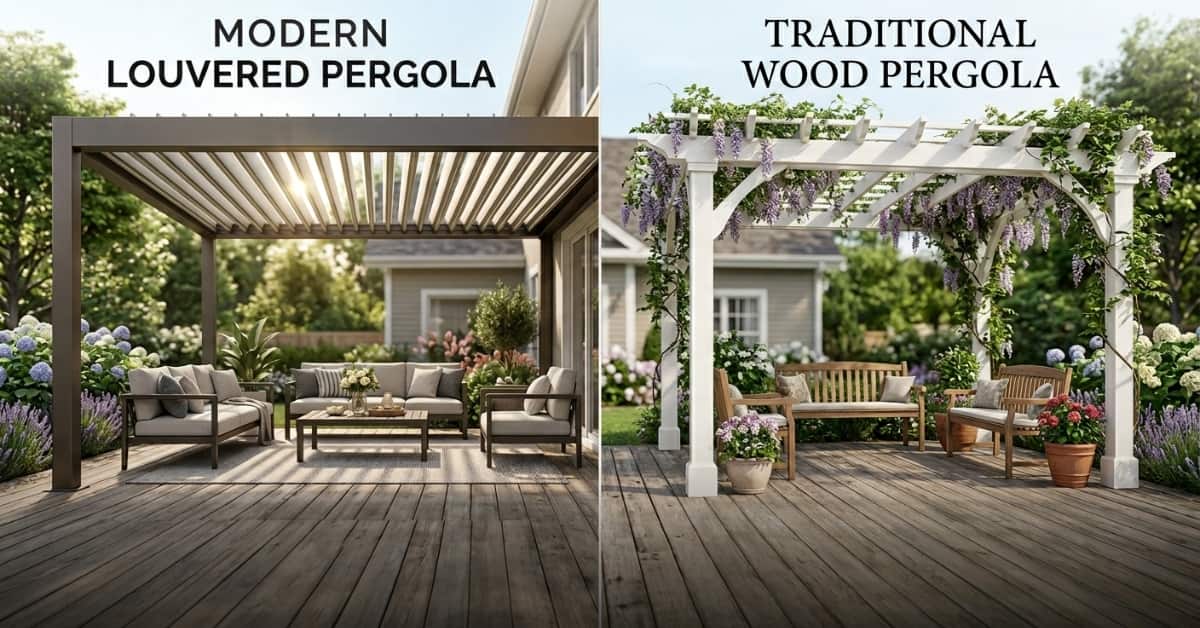
A traditional pergola has an open-beam roof structure — typically parallel rafters or a lattice pattern that lets light and air through freely. This design originated in warmer Mediterranean climates where shade is the goal but rain protection isn’t as critical. It provides partial shade, creates a defined outdoor zone, and looks beautiful in architectural photographs.
What it doesn’t do is keep you dry or block direct sun at high angles.
Louvered Pergola
A louvered pergola has a roof made of adjustable aluminum slats — the louvers — that rotate to control light, shade, and rain. Open them fully and you’ve got an open-air structure. Rotate them to 45 degrees for dappled shade. Close them completely and rain runs off through built-in drainage channels.
Add motorization and you control all of that from a remote, a wall switch, or your phone. For Florida’s climate, this level of control is genuinely transformative.
Traditional Pergola: The Honest Pros and Cons for Florida
Pros
• Lower upfront cost: Open lattice or beam structures require less material and less engineering than louvered systems.
• Classic aesthetic: The traditional pergola look integrates easily with older architectural styles and established landscaping.
• Good air circulation: Fully open structures allow unrestricted airflow, which helps in heat.
• Simpler installation: No motorized components, fewer technical requirements.
Cons
• No rain protection: In Florida, where afternoon storms are nearly daily from June through September, a traditional pergola offers zero rain shelter. You’re inside during every storm.
• Limited sun control: An open lattice provides partial shade at best. During peak sun hours, the light coming through at angles can still be intense.
• Material degradation: Wood traditional pergolas deteriorate quickly in Florida’s humidity and UV. Even aluminum open structures are exposed to all weather elements fully.
• Limited year-round usability: Realistically, a traditional pergola in Florida is fully usable for maybe 6-7 months of the year. Rain and intense heat limit the rest.
Louvered Pergola: The Honest Pros and Cons for Florida
Pros
• Year-round usability: This is the biggest benefit. Close the louvers when it rains. Open them when you want full sun. The space works in every season and every weather condition.
• Rain protection: Built-in drainage channels route water through the frame and away from your patio. Your furniture, food, and guests stay dry.
• Adjustable shade and light: Rotate the louvers to any angle for the exact amount of shade you want. This is something no fixed-roof structure can do.
• Motorization and automation: A motorized louvered pergola controlled by remote or smartphone adds a level of convenience that traditional structures simply can’t match.
• Durable materials: Quality louvered systems use all-aluminum construction with powder-coated finishes that handle Florida’s UV, humidity, and salt air without degradation.
• Higher property value: A well-designed, functional outdoor room adds measurable value to a Florida home.
Cons
• Higher upfront cost: A louvered pergola system costs more than an open traditional structure. The motorization, engineering, and materials account for the difference.
• More complex installation: Electrical rough-in, drainage routing, and structural engineering requirements are more involved. This is exactly why working with a dedicated manufacturer like Sarasota Pergolas matters — we manage all of this in-house.
Which One Makes More Sense for Florida?
Here’s our honest take: for most Florida homeowners, a louvered pergola is the smarter long-term investment. The additional upfront cost pays back quickly in usability. A traditional pergola sits unused for a significant chunk of the year. A louvered system gets used every day.
If budget is the primary constraint and you’re comfortable with limited wet-season usability, a traditional pergola can still be a meaningful addition to your outdoor space. But if you want a space you can actually count on regardless of what the weather is doing — and in Florida that’s a real daily consideration — the louvered option wins.
Automation Makes Louvered Systems Even Better
One of the things that sets modern louvered pergola systems apart is the automation technology behind them. Rain sensors that automatically close the louvers when moisture is detected. Timers that open them at sunrise. Integration with smart home systems. LED lighting control from the same panel or app that controls the louvers.
This level of functionality doesn’t exist in a traditional pergola design. It’s a meaningful lifestyle upgrade — and it’s one reason why motorized louvered pergolas have become the dominant choice in Florida’s outdoor living market
Check out how our pergola automation systems work, or explore our installation process to understand what’s involved in bringing one of these systems to your home.
Frequently Asked Questions
Is a louvered pergola worth the extra cost in Florida?
For most Florida homeowners, yes. The usability difference between a louvered pergola and a traditional open pergola in this climate is significant. The additional investment pays back in daily use rather than seasonal use.
Can a traditional pergola be converted to a louvered system later?
In most cases, a traditional pergola can’t be directly converted — the structural requirements differ. However, a renovation or replacement project can replace an existing open structure with a new louvered system. We handle these projects regularly.
How loud is a motorized louvered pergola during operation?
Our motorized systems operate quietly. The louver adjustment is smooth and low-noise — suitable for use early in the morning or during quiet evenings without being disruptive.
Do louvered pergolas require permits in Florida?
Yes. Sarasota Pergolas manages all permitting as part of every project. We know the requirements across all counties we serve.
Call Sarasota Pergolas at 941-544-0346 or visit our motorized louvered pergola page to see your options.